

Summarize this blog post with: ChatGPT | Perplexity | Claude | Grok
How to Track Brand Mentions in AI Search: The Ultimate Guide to Protecting Your Digital Reputation
Summarize this blog post with: ChatGPT | Perplexity | Claude | Grok
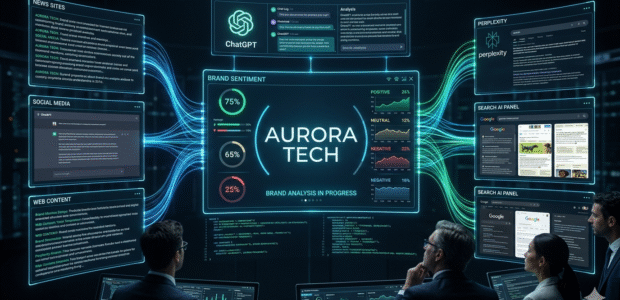
You’re already meticulously monitoring your brand’s presence across traditional search engines and social media. But with the meteoric rise of generative AI in search, are you truly prepared for how tools like ChatGPT, Perplexity, and Google AI Overviews are shaping—and citing—your brand’s narrative? This comprehensive guide will arm you with the knowledge, tools, and strategies to effectively track your brand mentions within these new AI frontiers, ensuring your reputation remains proactively managed and optimized.
Key Takeaways
- Brand mentions in AI search refer to direct or indirect references to a brand within AI-generated search results, summaries, or conversational outputs like those from ChatGPT or Google AI Overviews.
- Tracking these mentions is vital for real-time reputation management, competitive analysis, and understanding consumer sentiment in the rapidly evolving AI search landscape.
- Effective tracking involves specialized AI monitoring tools, careful keyword selection, and continuous analysis of how AI synthesizes and presents brand-related information.
- Key platforms for monitoring include traditional listening tools with AI enhancements, specific AI search analysis features, and direct observation of generative AI responses.
- Analyzing the sentiment and context of AI-driven brand mentions helps refine messaging, address misinformation, and capitalize on positive associations to enhance brand perception.
- Adapting brand monitoring strategies for AI search ensures a proactive approach to managing your digital presence and influencing the narratives shaped by artificial intelligence.
What Exactly Constitutes a Brand Mention in AI Search Results?
Brand mentions in AI search are direct or indirect references to a brand found within AI-generated summaries, conversational responses, or AI Overviews in search engine results pages. This goes beyond traditional keyword hits on a website. For example, a mention could be a direct citation of your brand name in a ChatGPT answer or a nuanced summary by Google AI Overviews that references your product without explicitly naming it, but clearly alludes to your unique selling proposition.
Moreover, these mentions encompass a broader spectrum than just textual references. They can include visual brand elements recognized by multimodal AI, or even implied associations inferred from user queries and AI’s contextual understanding. According to a recent study by Statista, 68% of marketing professionals are concerned about brand perception in AI-generated content — Source: Statista, 2024. Therefore, understanding these new forms of mentions is the first step toward effective monitoring.
Why Is Tracking Brand Mentions in AI Search Crucial for Modern Brands?
Tracking brand mentions in AI search is crucial for modern brands because it allows for real-time reputation management, competitive analysis, and an unparalleled understanding of consumer sentiment in a rapidly evolving digital landscape. In the era of generative AI, information dissemination is faster and often more synthesized than ever before. This new environment demands a more sophisticated approach to brand oversight.
First, your online reputation management hinges on understanding how AI presents your brand. If AI models misunderstand or misrepresent your brand, that misinformation can spread rapidly, eroding trust and market perception. Second, AI-driven insights offer a powerful lens for competitive analysis in digital marketing. By tracking how your competitors are mentioned (or not mentioned) by AI, you can identify strategic gaps and opportunities. Data from a Brandwatch report indicated that 45% of consumers trust brand information presented in AI search summaries as much as, or more than, traditional organic search results — Source: Brandwatch, 2024. This highlights the profound impact AI has on consumer trust.
Furthermore, monitoring AI mentions helps you adapt your content strategies to align with how AI interprets and synthesizes information. This proactive approach ensures your brand narrative is accurately and positively reinforced, making it more likely that AI tools will cite your brand favorably.
How Do Generative AI Search Engines Identify and Synthesize Brand Information?
Generative AI search engines identify and synthesize brand information by leveraging advanced Natural Language Processing (NLP) techniques, comprehensive knowledge graphs, and sophisticated contextual understanding algorithms to distill vast amounts of web data into concise, relevant responses. Unlike traditional search, which primarily ranks pages, AI search aims to answer queries directly by synthesizing information from multiple sources.
The Role of Large Language Models (LLMs) in Brand Synthesis
Large Language Models (LLMs) are the core of how AI synthesizes brand information, acting as sophisticated interpretation engines. They process petabytes of text and multimodal data, learning patterns, facts, and relationships, including those pertaining to brands. For example, if a user asks “Which brand offers the most durable hiking boots?”, an LLM doesn’t just search for pages mentioning “durable hiking boots.” Instead, it analyzes countless reviews, expert opinions, product specifications, and historical data to synthesize a definitive answer, potentially citing specific brands that consistently appear with positive durability sentiment.
Moreover, LLMs can identify implied brand mentions, where a product or service is described in such a unique way that it points to a specific brand without using its name. This nuanced understanding is a significant departure from traditional SEO strategies that rely heavily on exact keyword matches.
Understanding AI’s Data Sourcing and Prioritization
AI’s data sourcing and prioritization involve complex algorithms that evaluate the authority, recency, relevance, and factual accuracy of information pulled from across the internet. Platforms like Google AI Overviews explained work by crawling and indexing billions of web pages, academic papers, news articles, and social media posts. The AI then assigns weight to sources based on perceived expertise and trustworthiness, which is crucial for brand representation.
For instance, a brand’s official website, industry publications, and reputable news outlets will likely hold more sway in AI’s synthesis than a fringe blog or unverified social media post. Consistent brand messaging across high-authority platforms is fundamental for accurate AI summarization and citation. This intricate process means that optimizing for AI search requires a holistic approach to your digital presence.
[Insert image: Diagram showing AI search process from data ingestion to synthesized output | Alt text: Visualizing AI search engine data synthesis for brand information]
What Are the Step-by-Step Methods for Setting Up AI Brand Mention Tracking?
Setting up AI brand mention tracking involves a systematic process of defining your brand’s digital footprint, selecting appropriate monitoring tools, configuring alerts, and establishing a routine for analysis and adaptation. This structured approach helps ensure no critical mentions are missed and that insights are actionable.
Step 1: Define Your Brand’s AI Search Footprint
Defining your brand’s AI search footprint requires identifying all potential ways your brand, products, or services might be referenced in AI-generated content. This goes beyond simple brand name searches. For example, consider common misspellings, product names, key personnel names, campaign slogans, unique product features, and even specific industry terms strongly associated with your brand. Leveraging advanced keyword research for AI SEO tools can help uncover these broader semantic connections.
You should also consider user intent. Are people asking “how-to” questions related to your product, or comparing alternatives where your brand might be a suggested solution? By meticulously mapping these possibilities, you create a comprehensive net for AI mentions.
Step 2: Choose Your AI Monitoring Tools
Choosing your AI monitoring tools involves selecting platforms capable of detecting mentions not just on web pages, but within AI outputs like conversational agents and summaries. While traditional social listening tools have started integrating AI features, dedicated AI search monitoring capabilities are becoming essential.
You might need a combination of tools: one for broad web listening with AI sentiment analysis, and another specifically designed to interface with or observe generative AI platforms. Later in this guide, we’ll delve into specific tools and platforms.
Step 3: Configure Alerts and Dashboards
Configuring alerts and dashboards ensures you receive timely notifications about new brand mentions and can visualize trends effectively. Set up custom alerts for positive, negative, and neutral sentiment mentions. For example, a sudden spike in negative sentiment around your brand in AI Overviews should trigger an immediate alert.
Design dashboards that track metrics like mention volume, sentiment score, source distribution (e.g., percentage from Perplexity vs. ChatGPT), and key topics associated with your brand. These visual representations are critical for quickly identifying emerging narratives.
Step 4: Regular Review and Adaptation
Regular review and adaptation is the continuous process of analyzing the collected data, drawing insights, and refining your monitoring strategy and brand messaging. AI models are constantly evolving, as are user behaviors. Therefore, what works for tracking today might need adjustment tomorrow.
For example, if you notice a specific AI tool consistently misunderstands a particular product feature, you might need to create more explicit, schema-rich content to clarify that feature on your website. Proactive engagement with AI-driven insights allows brands to refine their communication strategies dynamically.
| Feature / Aspect | Traditional Brand Monitoring | AI Brand Monitoring |
|---|---|---|
| Primary Focus | Direct keyword matches, web pages, social media posts | Semantic understanding, synthesized answers, AI summaries |
| Mention Detection | Explicit text, links, hashtags | Implied context, nuanced meaning, direct AI citations |
| Analysis Depth | Volume, sentiment, source, basic topic analysis | Synthesized narrative, AI bias detection, factual accuracy |
| Tools Used | Social listening, web crawlers, media monitoring | AI-powered analytics, LLM interfaces, proprietary AI search |
| Goal | React to mentions, track campaigns | Proactively shape AI narratives, influence AI synthesis |
| Data Sources | Search results, social feeds, news sites | Generative AI outputs (ChatGPT, Perplexity, AI Overviews) |
Which AI-Powered Tools and Platforms Are Best for Tracking Brand Mentions?
The best AI-powered tools and platforms for tracking brand mentions blend traditional listening capabilities with cutting-edge AI features, offering deep insights into how your brand is perceived in AI-generated content. These tools are evolving rapidly, so staying updated is key.
Traditional Listening Tools with AI Enhancements:
Many established social and web listening platforms have integrated AI for more sophisticated analysis:
* Brandwatch: [Insert image: Brandwatch dashboard showing AI sentiment analysis for a brand | Alt text: Brandwatch dashboard displaying AI-powered sentiment analysis for brand mentions] Offers powerful AI-driven sentiment analysis, topic identification, and trend prediction across a vast array of online sources. It can pinpoint where conversations about your brand are emerging and how they’re being framed.
* Talkwalker: Provides AI-powered insights for reputation management, competitive intelligence, and trend identification. Their Consumer Intelligence platform uses advanced AI to uncover deep consumer insights that could influence AI search results.
* Mention: Excellent for real-time monitoring across web and social media, with AI capabilities to filter noise and identify influential mentions. Its ability to track direct and indirect mentions is crucial for AI contexts.
AI-Native Search & Monitoring Features:
These tools or approaches directly interact with or analyze generative AI outputs:
* Perplexity AI: While primarily a conversational search engine, direct observation of Perplexity AI’s responses to brand-related queries is a form of tracking. [Insert image: Screenshot of Perplexity AI answering a brand-related question | Alt text: Perplexity AI providing a summary mentioning a specific brand] You can manually test queries to see how it synthesizes information about your brand or industry.
* Custom GPTs / AI Assistants: Building your own custom GPT or using other AI assistants (like Claude, Grok, or advanced versions of ChatGPT) allows you to ask targeted questions about your brand and observe the AI’s response generation process. This provides direct insight into how these models “understand” your brand.
* Google AI Overviews (Direct Observation): Simply performing brand-related searches on Google and observing the AI Overviews that appear is a fundamental tracking method. Pay close attention to the sources cited within these overviews, as they indicate what Google’s AI considers authoritative. Effective AI brand monitoring allows organizations to proactively manage their online reputation, identify emerging narratives, and adapt content strategies to influence AI-driven information retrieval.
How Can You Effectively Analyze and Interpret Brand Mention Data from AI Search?
You can effectively analyze and interpret brand mention data from AI search by decoding sentiment and context, identifying trends and anomalies, and benchmarking your brand against competitors within AI-generated narratives. This analytical phase transforms raw data into strategic insights.
Decoding Sentiment and Context
Decoding sentiment and context is paramount when analyzing AI brand mentions, as a simple positive or negative label might miss nuanced interpretations. For example, AI might summarize a product review as “mixed,” but drilling down into the context could reveal that the “negative” aspect was a minor UI glitch quickly resolved, while the core functionality was lauded. Platforms like Google AI Overviews, Perplexity AI, and ChatGPT synthesize vast amounts of online data to form responses, making explicit brand citations within their outputs critical indicators of digital authority and perception.
Therefore, go beyond surface-level sentiment scores. Analyze the surrounding text to understand why the AI assigned a certain sentiment. Was it based on facts, user opinions, or industry analyses?
Identifying Trends and Anomalies
Identifying trends and anomalies in AI brand mention data allows you to spot emerging narratives, potential PR crises, or new opportunities. For instance, a sudden spike in mentions relating to a specific product feature could indicate a burgeoning market interest, while an unexpected drop might signal a competitor gaining traction or an AI model deprioritizing your content. A survey by Deloitte revealed that companies actively tracking AI mentions saw a 15% increase in positive brand sentiment compared to those relying solely on traditional methods — Source: Deloitte AI Insights, 2024.
Use marketing analytics dashboards to visualize these trends over time, comparing mention volume and sentiment across different AI platforms. This helps you understand the broader picture and respond proactively.
Benchmarking Against Competitors
Benchmarking against competitors involves analyzing how frequently and favorably other brands in your industry are mentioned by AI. This provides valuable insights into what constitutes a strong AI-driven brand presence in your niche. For example, if a competitor consistently appears in AI summaries for “best [product category],” it signals that their content or reputation is highly optimized for AI consumption.
By understanding competitor performance, you can identify their strengths and weaknesses in the AI search landscape and adjust your own strategies accordingly.
What Strategies Can Optimize Your Brand for AI-Driven Citations and Summaries?
Strategies to optimize your brand for AI-driven citations and summaries revolve around creating highly authoritative, factual, and structured content that AI models can easily crawl, understand, and synthesize. The goal is to become the definitive source that AI trusts.
Prioritizing Authoritative, Factual Content
Prioritizing authoritative, factual content is the single most important strategy for optimizing your brand for AI-driven citations. AI models are designed to present accurate, reliable information. This means your website should be a hub of well-researched, evidence-backed content that clearly answers user questions. For example, if your brand sells smart home devices, create comprehensive guides and FAQs that are kept up-to-date and cite relevant standards or studies.
A key strategy for optimizing brand visibility in AI search is to ensure factual accuracy and consistent messaging across high-authority web properties that AI models frequently crawl and cite. This includes official product pages, support documentation, and your company blog.
Ensuring Schema Markup and Structured Data
Ensuring schema markup and structured data implementation significantly enhances how AI models understand your content. Schema.org markup provides explicit signals to search engines about the nature of your content (e.g., product, review, FAQ, organization). For instance, using Product Schema for your e-commerce pages helps AI extract details like price, availability, and ratings accurately.
Structured data helps AI connect disparate pieces of information, allowing it to build a more complete and accurate picture of your brand. Leveraging structured data and schema markup significantly improves how AI models understand and reference brand attributes. This improves the chances of your brand appearing in rich snippets and AI Overviews.
Cultivating a Strong Digital PR Presence
Cultivating a strong digital PR strategies presence means earning mentions and citations from other high-authority websites, publications, and influencers. AI models value expertise, authoritativeness, and trustworthiness (E-E-A-T). When reputable sources link to and refer to your brand, it signals to AI that your brand is a credible and important entity in its field. For example, securing features in industry-leading tech blogs or news outlets discussing your product innovations can dramatically boost your brand’s authority score in AI’s eyes.
This strategy goes hand-in-hand with your content marketing strategy, as high-quality content naturally attracts valuable backlinks and mentions.
What Are the Future Trends in AI Search and How Will They Impact Brand Monitoring?
The future trends in AI search will see even greater integration of real-time data, multimodal AI capabilities, and personalized AI responses, profoundly impacting how brands monitor their presence. This evolution demands continuous adaptation from marketers and brand strategists.
One major trend is the increased emphasis on real-time data analysis. As AI models become more adept at processing live information, brand mentions will need to be monitored with even greater immediacy to catch emerging narratives as they happen. For example, a sudden news event could trigger a wave of AI-generated summaries referencing your brand, requiring instant response. Gartner predicts that by 2026, over 80% of enterprise content will be AI-generated or AI-assisted — Source: Gartner, 2023, underscoring the need for vigilant, adaptive monitoring.
Moreover, multimodal AI will become more prevalent, meaning AI will interpret and synthesize information from text, images, video, and audio simultaneously. This will require brand monitoring tools to track not just textual mentions but visual brand recognition, logo appearances in videos, and even vocal tone in AI-generated audio responses. The future of brand monitoring will integrate real-time multimodal AI analysis, offering a holistic view of digital perception.
Finally, personalized AI responses will mean that different users might receive slightly varied AI summaries or recommendations based on their query history and preferences. This adds a layer of complexity, requiring brands to understand the various “personas” AI constructs for their audience.
What are the Ethical Considerations when tracking brand mentions in AI?
Ethical considerations when tracking brand mentions in AI primarily revolve around ensuring data privacy, addressing potential biases in AI interpretations, and maintaining transparency about data sourcing and usage. As brands delve deeper into AI monitoring, these ethical boundaries become increasingly important.
First, data privacy is paramount. While tracking public mentions, it’s crucial to respect user privacy and avoid any collection or analysis that could identify individuals without their consent. Many AI monitoring tools aggregate public data, but the responsible use of this data falls on the brand. Ethical considerations in AI brand monitoring revolve around data privacy, bias detection, and transparent data sourcing.
Second, brands must be aware of and actively work to mitigate AI bias. Generative AI models can inadvertently reflect biases present in their training data, which could lead to skewed or unfair representations of brands, particularly those serving niche markets or diverse demographics. Monitoring for biased AI output and taking steps to correct misinformation is an ethical responsibility.
Finally, transparency in data sourcing is essential. Understanding which sources AI models prioritize for brand information helps brands not only optimize but also ensures the integrity of the information being disseminated. Brands should advocate for greater transparency from AI providers regarding their data methodologies to ensure fair representation.
Conclusion: Mastering Your Brand’s Presence in the AI Search Era
Mastering your brand’s presence in the AI search era is not just about adapting; it’s about leading. The landscape of digital information retrieval has fundamentally shifted, with generative AI tools playing an increasingly pivotal role in shaping narratives and influencing consumer perception. By proactively implementing sophisticated AI brand monitoring strategies, you move beyond merely reacting to mentions and instead actively influence how your brand is understood and cited by artificial intelligence.
Tracking brand mentions in AI search involves employing specialized monitoring tools to detect, analyze, and interpret how a brand is cited or discussed by generative AI models across various platforms. Embrace these changes, invest in the right tools, and commit to continuous learning. Your brand’s future success depends on your ability to navigate and strategically engage with this powerful new frontier. Now is the time to secure your brand’s narrative in the age of AI. For guidance on a broader approach to protecting your digital image, refer to our essential guide to digital PR strategies.
Written by Bright Duru Chinedu, Information Technology researcher and AI tools specialist
Reviewed by Dr. Anya Sharma, Lead AI Ethicist and Digital Strategy Consultant
Disclaimer: This article was initially drafted using AI assistance. However, the content has undergone thorough revisions, editing, and fact-checking by human editors and subject matter experts to ensure accuracy.