

Summarize this blog post with: ChatGPT | Perplexity | Claude | Grok
The Definitive Guide to Hidden Costs of AI Implementation for SMBs (What Most Businesses Miss)
Summarize this blog post with: ChatGPT | Perplexity | Claude | Grok
You’re likely exploring AI to boost your SMB’s efficiency and competitiveness, drawn by its impressive potential. However, many businesses overlook critical financial implications that extend far beyond initial software purchases. This comprehensive guide will expose the hidden costs of AI implementation, equipping you to budget accurately and ensure a truly successful, sustainable AI journey.
Key Takeaways
- Hidden AI costs for SMBs extend far beyond initial software licensing, encompassing data preparation, integration, maintenance, and training.
- Overlooking these unseen expenses can significantly inflate project budgets, diminish ROI, and lead to implementation failure.
- Data quality and preparation represent a major hidden cost, as AI models require clean, well-structured data to perform effectively.
- Integration with existing systems and ongoing maintenance are continuous financial commitments often underestimated by SMBs.
- Proactive cost assessment frameworks and strategic planning are essential for identifying and mitigating potential financial surprises in AI adoption.
- Investing in workforce training and addressing ethical considerations early can prevent future expenses and foster successful AI integration.
What Are the Primary Components of AI Implementation Costs for Small Businesses?
AI implementation costs for small businesses are the total financial outlays involved in deploying artificial intelligence solutions, stretching far beyond the initial purchase price to include a spectrum of often-overlooked expenses. Initially, many SMBs focus solely on the obvious direct costs. These typically include software licenses or subscription fees for AI platforms, API access charges, and sometimes basic consulting services to get started. However, a successful AI journey demands a much broader financial perspective.
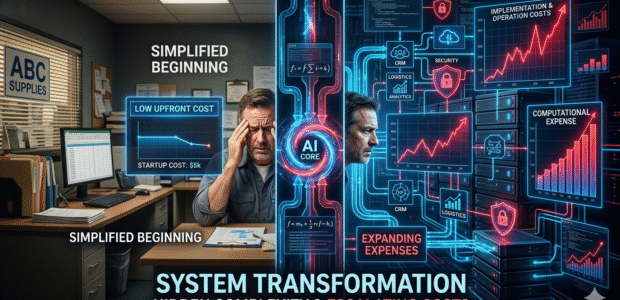
Moreover, these initial investments are just the tip of the iceberg. As such, the true financial picture unfolds as businesses delve deeper into the project. For example, a recent study indicated that while 70% of SMBs are exploring AI, only 30% accurately budget for post-implementation costs — Source: SMB Digital Trends Report, 2023. This often leads to significant budget overruns and project delays, impacting overall profitability and AI’s perceived value. Ultimately, understanding the full scope of both visible and hidden costs is paramount for SMBs to achieve a positive return on investment (ROI) from their AI initiatives.
Why Do Many SMBs Underestimate the True Cost of AI?
Many SMBs underestimate the true cost of AI because they often lack deep technical expertise in AI project management and overlook the complex ecosystem required for AI to function effectively. Business leaders are frequently captivated by the advertised benefits of AI — increased efficiency, automation, and enhanced decision-making — without fully grasping the underlying infrastructure, data requirements, and continuous operational demands. This gap in understanding creates a blind spot for critical financial implications.
In addition, the perception of “off-the-shelf” AI solutions can be misleading. Many cloud-based AI tools appear easy to integrate and cost-effective upfront. However, the reality of adapting these tools to specific business processes and data environments introduces complexities that generate unexpected expenses. For instance, hidden AI implementation costs for SMBs are unforeseen expenses that arise beyond initial software or service procurement, significantly impacting budget and ROI. This crucial oversight can turn a promising AI project into a financial burden. For more details on the big picture, read our guide on .
The Unseen Financial Burdens: Categories of Hidden AI Costs
The unseen financial burdens of AI implementation for SMBs encompass a wide array of expenses that, while not immediately apparent, are critical for the long-term success and sustainability of any AI initiative. Let’s explore these categories in detail.
How Do Data Preparation and Quality Impact AI Project Budgets?
Data preparation and quality significantly impact AI project budgets because AI models are only as good as the data they are trained on, requiring extensive cleaning, structuring, and labeling efforts that demand considerable time and resources. Raw data from various business systems is rarely in a format suitable for AI. This crucial preprocessing stage is frequently underestimated by SMBs. For example, a retail business wanting to use AI for personalized recommendations might have customer data scattered across CRM, POS, and loyalty programs, requiring consolidation and standardization before AI can even touch it.
Moreover, effective data preparation involves cleaning, structuring, and labeling datasets, often consuming up to 80% of an AI project’s initial effort and budget. This encompasses tasks like identifying and correcting errors, removing duplicates, handling missing values, and transforming data into a consistent format. Consider a manufacturing firm implementing predictive maintenance: sensor data might come in various units or formats, necessitating significant engineering work to normalize it. This extensive data work typically requires specialized skills or dedicated personnel, adding substantial overhead. [Insert image: Screenshot of a data cleaning software interface with highlighted anomalies | Alt text: Clean raw data with a data preparation tool]
What are the Hidden Expenses Associated with AI System Integration and Customization?
Hidden expenses associated with AI system integration and customization arise from the complex task of connecting new AI solutions with existing legacy systems, which rarely happens seamlessly and often requires bespoke development. Most SMBs operate with a patchwork of established software — ERPs, CRMs, accounting systems — that weren’t designed to communicate natively with modern AI tools. Bridging this gap is technically demanding.
Therefore, AI system integration involves connecting new AI solutions with existing legacy systems, a complex process that frequently incurs substantial customization and consulting fees. This might involve developing custom APIs, building data connectors, or modifying existing system configurations. For example, integrating an AI-powered chatbot with an existing customer service CRM means ensuring the chatbot can access customer history and update support tickets, which is often not an out-of-the-box feature. These customization efforts can quickly escalate costs, often requiring external expert consultants, whose hourly rates are typically high.
How Much Does Ongoing AI Maintenance and Support Really Cost SMBs?
Ongoing AI maintenance and support really cost SMBs more than anticipated because AI models are not “set it and forget it” solutions; they require continuous monitoring, retraining, and updates to remain accurate and effective over time. The business environment, customer behavior, and underlying data patterns constantly evolve. As such, AI models trained on past data will degrade in performance if not regularly maintained. This ongoing operational cost is a significant hidden expense.
Furthermore, ongoing AI maintenance includes model retraining, software updates, API management, and performance monitoring, essential for sustained accuracy and operational efficiency. For instance, an AI tool for fraud detection needs constant updates to recognize new fraud patterns. A model predicting sales trends must be retrained with new seasonal data or market shifts. This maintenance also extends to ensuring the underlying infrastructure is running optimally, managing software patches, and addressing any bugs or performance issues that arise. Many SMBs initially budget for a one-time deployment, failing to account for these continuous operational overheads.
What are the Training and Upskilling Costs Required for AI Adoption?
Training and upskilling costs required for AI adoption include significant investments in educating employees to effectively interact with and leverage new AI tools, extending beyond basic software tutorials to cover new workflows and decision-making processes. AI isn’t just a tool; it often redefines job roles and requires new skill sets. Employees need to understand not only how to use the AI interface but also how to interpret its outputs, validate its suggestions, and adapt their existing tasks around its capabilities.
Consequently, successful AI adoption requires significant investment in workforce training to equip employees with the skills needed to interact with and leverage new AI tools effectively. This might involve formal training programs, workshops, internal mentorship, or even hiring new talent with specialized AI literacy. For example, a marketing team adopting an AI content generation tool needs training on prompt engineering, ethical content review, and integrating AI-generated text into their overall strategy. These educational efforts can be substantial, both in terms of direct training fees and the opportunity cost of employees’ time away from their primary duties. Find more tips in our guide on .
How Do Security, Compliance, and Ethical AI Add to Implementation Expenses?
Security, compliance, and ethical AI add to implementation expenses by necessitating robust safeguards for data, adherence to complex regulatory frameworks, and thoughtful consideration of potential biases and fairness in AI decisions. Deploying AI, especially with sensitive customer or operational data, opens new vectors for cyber threats. Protecting this data is non-negotiable. Moreover, regulations like GDPR, CCPA, and industry-specific mandates often impose strict requirements on how AI systems collect, process, and store data.
Therefore, ensuring AI solutions are compliant and ethical requires dedicated resources. This includes investing in enhanced cybersecurity measures, conducting regular security audits, and developing clear data governance policies. Cybersecurity best practices are essential for SMBs adopting AI, as data breaches can result in significant financial penalties and reputational damage — Source: IBM Cost of a Data Breach Report, 2023, indicating average breach costs over $3 million for SMBs. Additionally, addressing ethical considerations, such as algorithmic bias or fairness, involves expert consultations and potentially costly data auditing. For robust protection, refer to our post on . To navigate the regulatory landscape, see our article on and for ethical frameworks, consult .
What Are the Long-Term Financial Implications of Scaling AI Solutions?
The long-term financial implications of scaling AI solutions involve rising infrastructure costs, increased maintenance complexity, and the need for continuous investment in more powerful computing resources as data volumes and model complexities grow. What starts as a small pilot can become a resource-intensive operation. As an AI system handles more data, serves more users, or processes more complex tasks, its demands on underlying hardware and software infrastructure escalate.
Furthermore, these scaling demands often necessitate upgrades to cloud computing services, specialized GPUs, or increased storage capacity. For example, a small business initially using AI for basic sentiment analysis might later want to expand to real-time predictive analytics across all customer interactions, requiring significantly more processing power. Unexpected infrastructure upgrades and scalability costs can quickly emerge as AI systems mature and process larger volumes of data or more complex tasks. This is particularly true for cloud-based AI, where usage-based billing models mean costs directly correlate with demand. Optimizing these resources is critical; explore our guide on .
Opportunity Costs and Change Management Challenges
Opportunity costs and change management challenges represent hidden financial burdens because the time and resources diverted to AI implementation could have been used elsewhere, and resistance to change can derail projects, leading to lost productivity. Every dollar spent and every hour dedicated to AI means foregoing other potential investments or initiatives. If an AI project fails or underperforms due to poor change management, the opportunity cost is substantial.
In addition, effectively managing the human element of AI adoption is crucial. Employees might resist new AI tools due to fear of job displacement, lack of understanding, or discomfort with new workflows. This resistance can slow down adoption, reduce productivity, and require additional resources for training and communication. Implementing AI fundamentally alters existing workflows and job functions, requiring robust change management strategies to ensure smooth adoption and avoid productivity dips. For example, a call center introducing an AI agent assistant might face pushback from human agents who feel threatened. Overcoming this requires proactive planning and communication, which incurs its own set of costs. Learn more about effective strategies in our article on .
Tools and Frameworks for Proactive AI Cost Assessment
Tools and frameworks for proactive AI cost assessment are systematic approaches and digital aids that help SMBs accurately predict, track, and manage the financial implications of AI implementation before and during deployment. Utilizing these resources can significantly reduce the risk of unexpected expenses. These can range from simple budgeting templates to sophisticated AI project management platforms.
For example, a comprehensive AI cost assessment framework might include stages for initial needs analysis, data readiness evaluation, integration planning, and ongoing operational cost projections. Employing a structured approach allows businesses to identify potential cost drivers early on. Consider using an AI readiness assessment tool that helps evaluate your current data infrastructure, skill gaps, and strategic objectives. This helps in developing an AI strategy from the ground up; refer to our guide on . [Insert image: Screenshot of an AI project cost estimation dashboard | Alt text: Estimate AI project costs with an online budgeting tool]
| Cost Category | Description | Key Hidden Elements | Assessment Tools |
|---|---|---|---|
| Data & Preparation | Acquiring, cleaning, and transforming data for AI models. | Manual data labeling, legacy system cleanup. | Data profiling tools, ETL software. |
| Integration & Customization | Connecting AI with existing IT infrastructure. | Custom API development, middleware licensing, consultant fees. | Integration platform as a service (iPaaS) solutions. |
| Maintenance & Operations | Sustaining AI model performance and infrastructure. | Model retraining, software updates, monitoring tools. | MLOps platforms, cloud cost management dashboards. |
| Training & Upskilling | Equipping employees to use and manage AI. | Lost productivity during training, specialized course fees. | Online learning platforms, internal workshop planning. |
| Security & Compliance | Protecting data and adhering to regulations. | Security audits, compliance software, legal consultations. | Cybersecurity assessment tools, data privacy frameworks. |
| Infrastructure & Scalability | Hardware, software, and cloud resources for AI. | Unexpected cloud usage spikes, specialized hardware upgrades. | Cloud cost calculators, infrastructure monitoring. |
When choosing the right AI tools, always evaluate not just their advertised features but also their ecosystem requirements and long-term costs. For a comprehensive overview, you can check our review of .
Strategizing for Success: Mitigating Hidden AI Expenses
Strategizing for success and mitigating hidden AI expenses involves proactive planning, meticulous budgeting, and a phased implementation approach that prioritizes cost transparency and risk reduction. Businesses can avoid budget shocks by adopting a structured methodology. This means moving beyond initial pilot projects with a clear understanding of the full lifecycle costs.
By way of illustration, start with a pilot project with clearly defined scope and success metrics. This allows for learning and adjustment before a full-scale rollout, minimizing larger financial risks. Furthermore, establish a cross-functional team that includes IT, finance, and business operations to ensure all cost perspectives are considered. What strategies can SMBs employ to mitigate unexpected AI costs? SMBs should focus on modular deployments, clear data governance policies, and continuous cost monitoring to avoid financial surprises. This holistic approach helps identify potential pitfalls early. For example, regularly reviewing cloud spending and model performance metrics can flag escalating costs before they become unmanageable. Calculating return on investment (ROI) accurately at each stage is also key; refer to our guide on .
When Should an SMB Consider Investing in AI, and What Should They Budget For?
An SMB should consider investing in AI when they have clearly identified a business problem that AI can uniquely solve, a clean dataset available, and a realistic understanding of the total cost of ownership. It’s not just about what AI can do, but what it should do for your specific business needs. A strategic approach is critical rather than jumping on the bandwagon. Roughly 65% of successful AI implementations in SMBs began with a clear problem statement and a dedicated AI budget — Source: Deloitte AI Trends Report, 2024.
Therefore, budgeting for AI extends beyond just the software. You should budget for data preparation (up to 50% of initial project costs), integration (10-20%), ongoing maintenance and support (15-25% annually of initial costs), training (5-10%), and security/compliance (5-10%). This comprehensive budget ensures that the foundational elements for AI success are adequately funded. For example, if your initial AI software license is $5,000, expect to allocate another $5,000-$15,000 for these hidden costs in the first year alone.
What Are the Long-Term Financial Implications of Scaling AI Solutions?
The long-term financial implications of scaling AI solutions include increasing operational expenditures for computing power, data storage, and specialized personnel, alongside the potential for exponential returns if managed effectively. As your AI systems mature and expand their scope, they will inevitably consume more resources. This growth isn’t linear. For instance, moving from processing thousands to millions of data points often requires a disproportionate jump in infrastructure investment.
At the same time, scaling also brings the opportunity for greater efficiencies and wider impact across the business. Proper long-term financial planning should account for variable cloud computing costs, potential hardware upgrades, and the ongoing need for expert AI/ML engineers. The key is to optimize resource utilization from the outset, using cloud cost management tools and right-sizing your infrastructure. Proactive monitoring of infrastructure usage and model performance can help SMBs manage scaling costs effectively and prevent unexpected spikes.
Conclusion: Embracing AI Wisely for Sustainable Growth
Embracing AI wisely for sustainable growth means approaching AI implementation with a clear-eyed understanding of its full financial landscape, extending far beyond the initial purchase price. By acknowledging and planning for the hidden costs associated with data preparation, integration, maintenance, training, and compliance, SMBs can transform potential pitfalls into pathways for true innovation.
Ultimately, successful AI adoption isn’t just about deploying technology; it’s about strategic investment in data, people, and processes. As such, proactively assessing costs, employing robust frameworks, and fostering a culture of continuous learning will enable your SMB to harness AI’s transformative power without being blindsided by unforeseen expenses. Start your AI journey informed, budget comprehensively, and build a future where AI genuinely drives your business forward.
Written by Bright Duru Chinedu, Information Technology researcher and AI tools specialist, focusing on practical AI applications for business.
Reviewed by AI Strategy Expert, dedicated to helping SMBs navigate complex technology landscapes.
Disclaimer: This article was initially drafted using AI assistance. However, the content has undergone thorough revisions, editing, and fact-checking by human editors and subject matter experts to ensure accuracy.